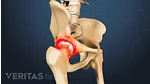
Experts estimate that people have a 25% risk of developing hip arthritis during their lifetimes. 1 Murphy et. al, "One in four people may develop symptomatic hip osteoarthritis in his or her lifetime," Osteoarthritis and Cartilage 18 (2010): 1372-1379. Most people who develop hip osteoarthritis exhibit at least one of the risk factors listed below.
In This Article:
- What Is Hip Osteoarthritis?
- Hip Osteoarthritis Symptoms
- Hip Osteoarthritis Causes and Risk Factors
- Hip Osteoarthritis Diagnosis
- Hip Osteoarthritis Treatment
- Surgery for Hip Osteoarthritis
- Hip Osteoarthritis Video
Abnormality of the hip joint
Some people may develop or genetically inherit poor bone alignment between the hip’s ball and socket. This poor alignment can eventually lead to hip osteoarthritis. Conditions that feature poor hip joint alignment include hip dysplasia, congenital hip dislocation, and femoroacetabular impingement (FAI).
See Hip Anatomy
Joint trauma or injury
A broken hip, torn labrum (the labrum is a piece of tough cartilage that rings the hip’s socket), or other trauma can lead to symptoms of hip osteoarthritis years or even decades later.
Watch: Hip Pain from a Labral Tear Video
History of high-impact activity
In general, staying active is one of the best ways to prevent any kind of osteoarthritis, including hip osteoarthritis. However, some evidence suggests that elite athletes who participate in years of direct impact sports, such as hockey and football, may be at an increased risk of developing hip osteoarthritis.
2
Gouttebarge V, Inklaar H, Backx F, Kerkhoffs G. Prevalence of osteoarthritis in former elite athletes: a systematic overview of the recent literature. Rheumatol Int. 2015;35(3):405–418. doi: 10.1007/s00296-014-3093-0.
Similarly, people who have a history of manual labor, such as farmers, also seem to be at increased risk.
3
Harris EC, Coggon D. HIP osteoarthritis and work. Best Pract Res Clin Rheumatol. 2015;29(3):462–482. doi:10.1016/j.berh.2015.04.015.
Advanced age
Over a lifetime, the hips experience wear-and-tear, and cartilage thins and becomes less flexible. Most people who have hip osteoarthritis that can be seen on an x-ray are over the age of 60.
4
Muraki S, Akune T, Oka H, et al. Incidence and risk factors for radiographic knee osteoarthritis and knee pain in Japanese men and women: A longitudinal population-based cohort study. Arthritis Rheum 2012 May;64(5):1447-56. DOI: https://doi.org/10.1002/ art.33508. As cited in Lespasio MJ, Sultan AA, Piuzzi NS, et al. Hip Osteoarthritis: A Primer. Perm J. ;22:17–084. doi:10.7812/TPP/17-084.
Genetics
Experts estimate that 60% of hip arthritis cases are influenced by genetics.
5
MacGregor AJ, Antoniades L, Matson M, Andrew T, Spector TD. The genetic contribution to radiographic hip osteoarthritis in women: results of a classic twin study. Arthritis Rheum. 2000;43(11):2410–6. As cited in Murphy NJ, Eyles JP, Hunter DJ. Hip Osteoarthritis: Etiopathogenesis and Implications for Management. Adv Ther. 2016;33(11):1921–1946. doi:10.1007/s12325-016-0409-3.
This figure does not mean that 60% of all hip osteoarthritis cases are strictly inherited. It just means that genetics—along with other risk factors—may play a part in them. Evidence suggests that, when it comes to hip arthritis, maternal genes have a greater influence than paternal genes.
Sex
Women are thought to have about a 10% greater risk of developing hip osteoarthritis.
1
Murphy et. al, "One in four people may develop symptomatic hip osteoarthritis in his or her lifetime," Osteoarthritis and Cartilage 18 (2010): 1372-1379.
Obesity
Researchers suggest that a 5-point increase in BMI (about 25 lb or 30 lb for most people) is associated with an 11% increased likelihood having hip osteoarthritis.
6
Jiang L, Rong J, Wang Y, et al. The relationship between body mass index and hip osteoarthritis: a systematic review and meta-analysis. Jt Bone Spine. 2011;78(2):150–5.
Unlike knee osteoarthritis, the relationship between obesity and hip osteoarthritis is not definitive. 7 Murphy NJ, Eyles JP, Hunter DJ. Hip Osteoarthritis: Etiopathogenesis and Implications for Management. Adv Ther. 2016;33(11):1921–1946. doi:10.1007/s12325-016-0409-3. Some experts suggest that excess weight may not be a risk factor in the initial development of hip arthritis but speeds up its progression. 1 Murphy et. al, "One in four people may develop symptomatic hip osteoarthritis in his or her lifetime," Osteoarthritis and Cartilage 18 (2010): 1372-1379.
Low birth weight
Research suggests that low weight at birth and preterm birth may increase the risk of developing hip osteoarthritis.
8
Hussain SM, Ackerman IN, Wang Y, Zomer E, Cicuttini FM. Could low birth weight and preterm birth be associated with significant burden of hip osteoarthritis? A systematic review. Arthritis Res Ther. 2018;20(1):121. Published 2018 Jun 8. doi:10.1186/s13075-018-1627-7.
It may be that low birth weight and preterm birth are associated with minor hip abnormalities that result in excess pressure and wear-and-tear on the joint, contributing to the eventual development of osteoarthritis.
The risk factors above increase a person’s chance of developing hip osteoarthritis but do not guarantee it. Conversely, those who have none of the risk factors may still develop hip osteoarthritis.
- 1 Murphy et. al, "One in four people may develop symptomatic hip osteoarthritis in his or her lifetime," Osteoarthritis and Cartilage 18 (2010): 1372-1379.
- 2 Gouttebarge V, Inklaar H, Backx F, Kerkhoffs G. Prevalence of osteoarthritis in former elite athletes: a systematic overview of the recent literature. Rheumatol Int. 2015;35(3):405–418. doi: 10.1007/s00296-014-3093-0.
- 3 Harris EC, Coggon D. HIP osteoarthritis and work. Best Pract Res Clin Rheumatol. 2015;29(3):462–482. doi:10.1016/j.berh.2015.04.015.
- 4 Muraki S, Akune T, Oka H, et al. Incidence and risk factors for radiographic knee osteoarthritis and knee pain in Japanese men and women: A longitudinal population-based cohort study. Arthritis Rheum 2012 May;64(5):1447-56. DOI: https://doi.org/10.1002/ art.33508. As cited in Lespasio MJ, Sultan AA, Piuzzi NS, et al. Hip Osteoarthritis: A Primer. Perm J. ;22:17–084. doi:10.7812/TPP/17-084.
- 5 MacGregor AJ, Antoniades L, Matson M, Andrew T, Spector TD. The genetic contribution to radiographic hip osteoarthritis in women: results of a classic twin study. Arthritis Rheum. 2000;43(11):2410–6. As cited in Murphy NJ, Eyles JP, Hunter DJ. Hip Osteoarthritis: Etiopathogenesis and Implications for Management. Adv Ther. 2016;33(11):1921–1946. doi:10.1007/s12325-016-0409-3.
- 6 Jiang L, Rong J, Wang Y, et al. The relationship between body mass index and hip osteoarthritis: a systematic review and meta-analysis. Jt Bone Spine. 2011;78(2):150–5.
- 7 Murphy NJ, Eyles JP, Hunter DJ. Hip Osteoarthritis: Etiopathogenesis and Implications for Management. Adv Ther. 2016;33(11):1921–1946. doi:10.1007/s12325-016-0409-3.
- 8 Hussain SM, Ackerman IN, Wang Y, Zomer E, Cicuttini FM. Could low birth weight and preterm birth be associated with significant burden of hip osteoarthritis? A systematic review. Arthritis Res Ther. 2018;20(1):121. Published 2018 Jun 8. doi:10.1186/s13075-018-1627-7.